
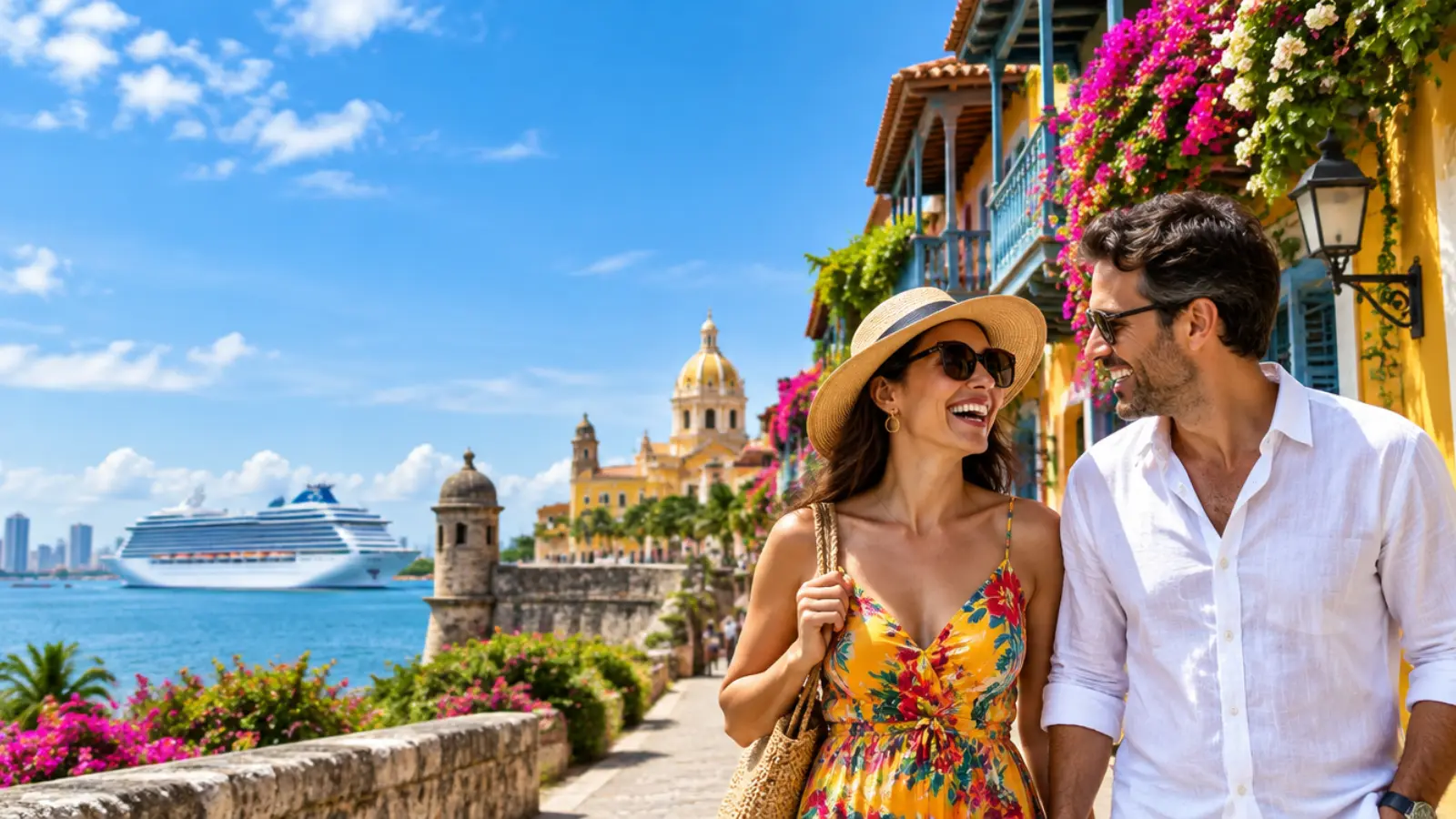
Cartagena: a walled Spanish city, a giant fortress and sloths at the pier.
Cartagena is the showpiece stop on Panama Canal cruises and the deep Southern Caribbean: a 16th-century walled city of balconies, plazas and bougainvillea that UNESCO protects, with the biggest Spanish fort in the Americas on the hill behind it. Ships dock at the Terminal de Cruceros in Manga, about 2 to 3 miles from the walls, with a free shuttle from the pier to the terminal building and its free wildlife park, then a short cab or tour bus into town. SmartCruiser lists every cruise that calls at Cartagena from every line, priced with taxes, fees and port expenses included, with the sailings that carry SmartCruiser bonus onboard credit or instant savings at the top.
Three ways to do Cartagena
The walled city and the fortress with a guide, the old town on your own, or a boat day to the Rosario Islands; the buttons filter the list of sailings below.
Walled city and Castillo San Felipe with a guide
- Climb the ramps and tunnels of the 1657 Castillo San Felipe de Barajas, then walk the Plaza de Bolivar, the cathedral and the Las Bovedas vaults
- Most ship tours add the La Popa monastery for the city view and a shopping stop for emeralds; 4 to 5 hours, about $70 to $110 a person
- Horse-carriage and classic-car versions of the city tour run about $100 to $150
Best for: first-timers, history lovers, anyone nervous about going alone
The old town and Getsemaní by taxi
- A taxi from the terminal rank to the Clock Tower gate is about $10 to $20 per cab, set at the terminal, 10 to 20 minutes depending on traffic
- Walk the walls at the Baluarte de Santo Domingo, duck into the Palace of the Inquisition and sip coffee in the Plaza Santo Domingo
- Getsemaní next door is the street-art and cafe quarter; the Plaza de la Trinidad is the spot for lunch
Best for: repeat visitors, walkers, photographers
Rosario Islands boat day
- Speedboats run 45 to 60 minutes to the coral islands for snorkeling, a beach club and lunch; about $90 to $150 through the ship
- Bocagrande, the high-rise beach strip, is 15 minutes from the port if you only want sand and a swim
- Pick the islands only on 9-hour-plus port days and book through the ship for the guaranteed return
Best for: sun seekers, snorkelers, long port days
Cartagena cruises: SmartCruiser picks first
Every cruise that calls at Cartagena from every line, priced live with taxes, fees and port expenses included. The picks at the top are sailings where booking with SmartCruiser gets you something extra: instant savings or bonus onboard credit. Below them, every other sailing that stops here, with full sorting by home port, line, month, length and price.
SmartCruiser picks
Sorted by what you save, biggest firstEvery cruise that calls at Cartagena
Stack any filters, then pick a sortPrices are per person, double occupancy, in US dollars, and include cruise fare, taxes, fees and port expenses as published by the cruise line at the moment you load this page. Fares are capacity controlled and change daily; the fare is confirmed when you book. Flights, hotels and transfers are extra unless the line’s offer says otherwise. SmartCruiser instant savings and bonus onboard credit are provided by SmartCruiser on top of the cruise line’s price and are not available when booking direct; amounts are per stateroom, vary by stateroom category and are shown for the lowest category offered. Special SmartCruiser rates are pricing SmartCruiser holds on that sailing for its clients, with extra onboard credit; you book your own stateroom and travel on your own. Senior fares apply to guests 55 and over; resident fares need proof of residency in a listed state or province at check-in; police and fire fares apply to active or retired police, fire and EMT personnel with ID. Qualifier-fare savings are measured against the best fare the cruise line offers the general public for the same stateroom category on the day the list was pulled, updated weekly.
Home ports that sail to Cartagena
Cartagena is the Caribbean-side stop on nearly every Panama Canal cruise and on the longest Southern Caribbean loops; pick a home port and the list above narrows to cruises leaving from there.
Things to do in Cartagena
A UNESCO walled city, the largest Spanish fortress in the New World, emeralds, coffee and a free wildlife park at the pier.
Which lines call at Cartagena?
Every line that sails the Panama Canal calls at Cartagena, and the long Southern Caribbean itineraries add it as the southernmost stop.
When to go
Cartagena is hot and humid all year with highs in the upper 80s and sits outside the hurricane belt; December to April is the dry, breezy, busiest season and September to November the rainiest.
Cartagena questions we answer every day
Where do ships dock in Cartagena and how far is the walled city?
Ships dock at the Terminal de Cruceros in the Manga district, a commercial port with two cruise berths, where free shuttle buses run the quarter mile from the pier to the terminal building, the taxi rank and the wildlife park. The walled city is about 2 to 3 miles away through the port and a busy road with no sidewalks, so do not walk it; a taxi takes 10 to 20 minutes. No ships tender here.
How do I get around and what do taxis cost?
Licensed yellow taxis line up outside the terminal with fares posted per cab, not per person: figure about $10 to $20 per taxi to the Clock Tower gate for up to four people, and about $30 to $40 an hour for a driver who waits. Pay in dollars or pesos and carry small bills. Uber and other apps work in town but are not allowed to pick up inside the port. Inside the walls everything is on foot; it is a 15-minute walk end to end.
What currency, language and time zone?
The Colombian peso is the money, roughly 4,000 to the dollar, but US dollars are taken by taxis, tour sellers and most shops in the old town, with change in pesos; cards work in restaurants and the emerald stores. Spanish is the language and English is common in the tourist trade. Cartagena is on Colombia time, the same as US Eastern Standard all year, so it matches Florida in winter and is an hour behind in summer. US phones roam on most plans.
Is Cartagena safe?
The walled city, Getsemaní and Bocagrande are heavily policed tourist zones that cruise lines have used for decades, and with normal city sense you will be fine. The U.S. State Department rates Colombia at Level 3 for parts of the country, but Cartagena’s tourist areas are not the concern. Practical rules: use the terminal taxis, keep phones and jewelry low-key, say a firm no gracias to the vendors, stay inside the walls and Getsemaní, and skip the beach vendors’ massages and the street emerald sellers. If you worry about timing, take a ship tour.
What is the best excursion, and should I book it through the ship?
The fortress-plus-walled-city tour, about 4 to 5 hours, is the one everyone should do once; add La Popa if the tour includes it. Repeat visitors can skip the bus, cab to the Clock Tower and wander. For the Rosario Islands, book through the ship: the boats leave early, the park fee and lunch are included, and the ship waits for its own tour. Independent walking tours in the old town are fine on any port day of 8 hours or more.
Do I need a passport?
If your cruise starts and ends in the same US port, US citizens can sail with a government photo ID plus an original birth certificate under the closed-loop rule, but we strongly recommend a passport for Cartagena: Colombia requires one to enter by air, so it is your only way home if you miss the ship, and every full Panama Canal transit (Florida to the West Coast, or Seattle to Florida) is one-way and requires a passport book for everyone.
Are taxes and fees included in the prices here?
Yes. Every price on this page includes the cruise fare, taxes, fees and port expenses. Flights, hotels, shore excursions and gratuities are extra.
Talk to a Cartagena cruise specialist
We know which Panama Canal and Southern Caribbean sailings give you the longest Cartagena day and which carry SmartCruiser bonus onboard credit, so call to check availability and book. Monday to Thursday 9 to 6, Friday 9 to 5, Saturday 10 to 6 ET.